Banquet Piece, Pieter Claez

Showing posts with label History. Show all posts

Tuesday, May 26, 2020

Where was Fancher Creek Nursery and the Roeding place?


David Rumsey Township 13 South, Range 21 East. 
(Compiled, drawn and published ... by Thos. H. Thompson, Tulare, California, 1891)
Note: F.T. Eisen was the neighbor to F. Roeding


Saturday, January 30, 2016

Early California Horticulture Publications

California Horticulture

Just ran into this really lovely illustration on the cover of California Horticulture by George C. Roeding.

Starting a page to collect all of these early horticultural books and booklets.


Sunday, January 11, 2015

The Giant Amsinckia of Union City

 This giant Amsinckia flower is stretched oout over five or six stories overlooking a play ground in Union City near the BART station. Kudos to the artist!

Who painted this amazing mural?

It was Mona Caron. Check her on Facebook and on Laughing Squid.

Friday, December 12, 2014

Hanging Pensively, Miss Pendula of Niles

Humorous Horticultural Writing from the library

Niles Redwood Develops 'Flop'

Sequoia Giganticus Branches Grow in All Directions on Freakish Tree


"An occasional diversion of species into the "cuckoo class" seems a privilege given by Nature to other than human beings.

"At the gardens of the California Nursery Company in Niles a specimen of the Sequoia Gigantea, California's favorite wonder tree, has gone so completely "haywire" that it is given an extra nursery-Latin handle to describe it. This acquired adjective is Pendula, meaning to hang pensively.

Thursday, December 4, 2014

The Palms go to the Panama-Pacific International Exposition

The California Nursery Company in Niles supplied many palm trees for the Panama Pacific International Exposition. In the 1915 catalog, there is a photo of Canary Island palms on a railcar. It says "Trainload of large Phoenix canariensis. Were planted on Palm Avenue at 1915 Exposition."



Sunday, November 16, 2014

California Nurserymen Knee-slappers!

"During the last year much has been said and written about the Avocado, known in Mexico as the "Ahuacate," in Peru as "Palta," in the West Indies as "Midshipmen's Butter," but generally spoken of here in the United States as "Alligator Pear." I expect you will think some of the stories I will tell about the income from individual trees will sound pretty big, but you know we of the southern end of the State have the reputation of being very careful, when speaking of our section or resources, not to speak of them in too small a way.


Saturday, November 15, 2014

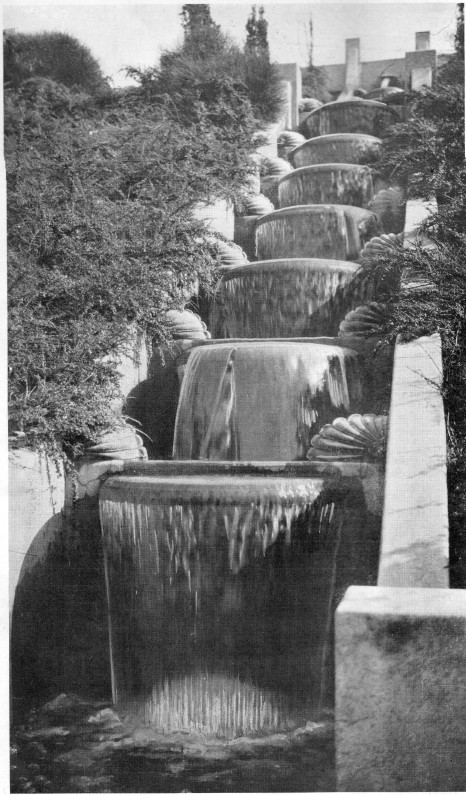
Considering Cascades

From a 1931 picture from
the Friends of the Cleveland Cascade.
The cascades were lit
with different colors of light.
I recently ran across a reference to the Cleveland Cascade. It is not in Cleveland, but is a water work that cascades down a portion of too-steep-for-cars Cleveland Street in Oakland. I found this reference through a strange series of searches from tulips, to the California Nursery Company spring flowering bulbs shows, to Howard Gilkey who designed Oakland flower shows, and finally to the Cleveland Cascades.

We went over to see the Cleveland Cascade today. Unfortunately the basins were all removed and so now there are just steps. Lots of people are still enjoying the steps as their daily exercise. It sure beats the gym.

The Nurserymen Discuss the Merits of Native Plants, 100 Years Ago

One hundred years ago, the members of the California Association of Nurserymen (CAN) were talking about growing and selling California native plants.

Many of the nurserymen at a meeting in 1913 were very enthusiastic about native plants: They are beautiful. They don't need summer water when they are established. They harmonize with the natural landscape. We should be selling them.


Friday, November 14, 2014

Tracking down Luther Burbank, two girls, and a dog

I recently saw two intriguing photos in the California Nursery Company archives. In the photos Luther Burbank is standing in a group near two girls and a dog in the front row. George C. Roeding is also in the front, on the right. Probably lots of other movers and shakers of the nurseryman world in these photos. Who are they? I was curious.


Thursday, November 13, 2014

Nursery and Exposition Logos, 1912 - 1913


A smattering of logos from the Transaction and Proceedings of the Second Annual Meeting of the California Association of Nurserymen, Held in Oakland, on Thurs. Fri. and Sat. November 7-9, 1912 and the Transaction and Proceedings of the Third Annual Meeting of the California Association of Nurserymen, Held in Fresno, on Thurs. Fri. and Sat. October 16-18, 1913.


Sunday, October 12, 2014

The Quincunx, mystically considered


Huge fan, I am, of reading old gardening books.

While looking for some good pictures of roses for the current Días de los Muertos art project, I ran across this odd word - Quincunx. Odd and old, not to mention hard to pronounce.

Wikipedia has an entry for it. Merriam Webster has a definition. Visually it is the five spot on a domino - four dots on the corner and one in the middle.  The origin is thus: "Latin quincunc-, quincunx, literally, five twelfths, from quinque five + uncia twelfth part". According to MW, first known use was 1485. Now I'm still thinking how does 5/12 relate to planting.

Both the California Nursery and Fancher Creek Nursery talked about orchard planting and the Quincunx. Roeding's Fruit Growers Guide (1919) probably helped disseminate the information.

Monday, September 29, 2014

Visiting with your favorite deceased horticulturist

The redwood has embraced this gravestone.
This is an early start to thinking about this year's Días de los Muertos. Maybe these are thoughts you have when you take out the old tomatoes and start thinking about planting fava beans.

Last week our landscape drawing class had a field trip to the Mountain View Cemetery. On the way up the hill, Bryn and Robert and I had a conversation which, because we were in a cemetery, it was only slightly morbid. Where did we want to be parked when we are done with our earthly bodies?

Over the years of taking care of the older folks, I have decided that I want to be sprinkled about in some of my favorite mushroom hunting grounds. I'm hoping to hitch a ride up and down the xylem and phloem of a redwood until I settle into a ring of wood. That redwood might be long lived enough that I could spend some time there before being made into a fence or a mole den.

So that's what I said - I just want my folks (whoever they are at that time) to sprinkle me up and down the coastal forests. [and that includes some local ones which shall remain nameless]

Friday, August 1, 2014

Sequoiadendron giganteum...Who named it first?

"Hermit and Burnt Tree" from Calisphere.

The "Big Tree" has had many names and there is much interesting controversy over how it was named and claimed. This is but one of many articles that I have found in google books and Internet Archive and other archives.

What I have read elsewhere is that the English scooped the Californians in describing the tree now known as Sequoiadenron giganteum. To the Americans it must have seemed very nervy and audacious when Dr. Lindley named our great tree after one of the English military greats, the Duke of Wellington. How much sense did that make? Apparently it's ok if you are the first one out of the gate. But not surprisingly there was a bit of fallout and controversy. And as you know, it didn't stick, except in the U.K. where you can still see signs for the "Wellingtonia".

Monday, July 28, 2014

Stripy Rainbow Tulips at Holland's flower garden, the Keukenof


At an early age, I must have decided that flowers
could be stripy rainbow colors.
Orbiting above the flower and the earth,
I think it might be John Glenn,
also in rainbow color.
Our TVs were black and white
but our imagination was in color.
Keukenof is world famous for its spring flowering bulb displays. Their English landscape style garden near Amsterdam is huge. It takes a couple of hours to see the gardens.

In my family, flowers are not necessarily everyone's favorite thing to look at in large quantities, but luckily it was Mother's Day when we visited. And so I was able to cash in on that happy circumstance. I am so glad we went. It was the last weekend they were open to the public and many of the beds had already finished up. There was still an amazing display of flowers.

Friday, July 11, 2014

Tomato Sepal Sprites


At this time of the year, Tomato Season, I am always amused by the tops of the fresh garden tomatoes. Also known as the sepals of the tomato flower and fruit, the tops are very animated looking, almost like little happy people.


Sunday, June 8, 2014

F. W. Meyer, author of "The Rock Garden" column... Who was he?

F.W. Meyer wrote many articles in the journal The Garden in the early 1900's. I wrote about "The Rock Garden" column in a previous blog. But, who was he? Where did he create these rock gardens? Can I go see one?

Wednesday, November 13, 2013

Monumental Trees, World-wide, and especially in Belgium

Castle Bleu in Trooz
The Monumental Trees website tracks trees, world-wide, that are monumental in some way - the oldest, tallest, biggest, thickest. Anyone can add to their database. Giant sequoia seems to be a favorite.

You can find the monumental trees in Belgium. Listed are 1448 specimens of various species. And you can find Giant Sequoia trees that are growing in Belgium! Today there are 956 Sequoias listed. I had trouble clicking on the marker except when I was in the big map. Look at all of those trees! Indeed, the Castle of Dave has three specimens! Mammoetbomen! Not so often, do you see a castle with a Giant Sequoia. Or do you if you are looking outside of California?

Friday, October 25, 2013

The California Nursery Company's Ramona Float in the 1929 Fiesta de las Rosas

The California Nursery Company float
in the 1929 Fiesta de las Rosas parade.
"The Wedding Scene from "Ramona'' was the
presentation of the California Nursery Company
of Niles, California."
Photographer - Frank Steiner, May 18, 1929
From OCLC WorldCat
In 1929 the California Nursery entered the Fiesta de las Rosas parade in San Jose with this float featuring Ramona's wedding place. Read the souvenir booklet and find the nursery's float on page 16.

San Jose has a very long history of parades to celebrate roses and to highlight San Jose as a "garden city". In 1896, the first "Carnival of the Roses" parade was held.  The Rose Carnival became the "Fiesta de las Rosas" in 1926.  The parade has since transformed into the Rose, White, and Blue parade.

What was the inspiration for this float in 1929? 


This was around the time that George C. Roeding, Jr. was thinking about renovating (or was in the process of renovating) the old Vallejo Adobe building. The 1931 catalog announced that the adobe would soon be renovated. The cover featured a beautiful pen and ink drawing of the Old Adobe.  See related article about Fred Reimers who transformed the adobe from functional to beautiful.

In 1928 "Ramona" was released. This silent movie starred Dolores del Rio and Warner Baxter. (For many years it was thought to be lost. Now you can find it online.) See the book Ramona Memories for how Helen Hunt Jackson's novel affected the selling of California for years and years. Bruce Roeding was not aware of any connection with Ramona, but then he was born in 1928!

Sunday, August 25, 2013

The Garden of the Vallejo Adobe - Designed by Johannes Reimers


What did the garden around the "Old Adobe" look like? There are black and white pictures, but the cover of the 1939 catalog is probably how the Roeding family saw it. (The catalog flipped the original painting to make the front door be on the cover!). [2021 update! Movies from California Revealed]

Johannes Reimers designed the garden surrounding the Old Adobe around the time that the adobe was renovated by his son, the Bay Area architect, Frederick Reimers.

The 1931 catalog says that the owners plan to renovate the old building and that the grounds are being appropriately landscaped.

Why was Johannes Reimers chosen to do the garden?

A Walk Around the Old Vallejo Adobe

The garden around the Vallejo Adobe is often referred to as the "Reimers garden".   So far, I found this out about Johannes Reimers.  The original design for the garden still exists in the archives (supposedly). 

Johannes Reimers could be considered (at least by me) a really early drought-tolerant garden planner. He planned gardens for some of the driest most neglected areas, railroad stations.