
Banquet Piece, Pieter Claez

Sunday, November 16, 2014
California Nurserymen Knee-slappers!

Saturday, November 15, 2014
Considering Cascades
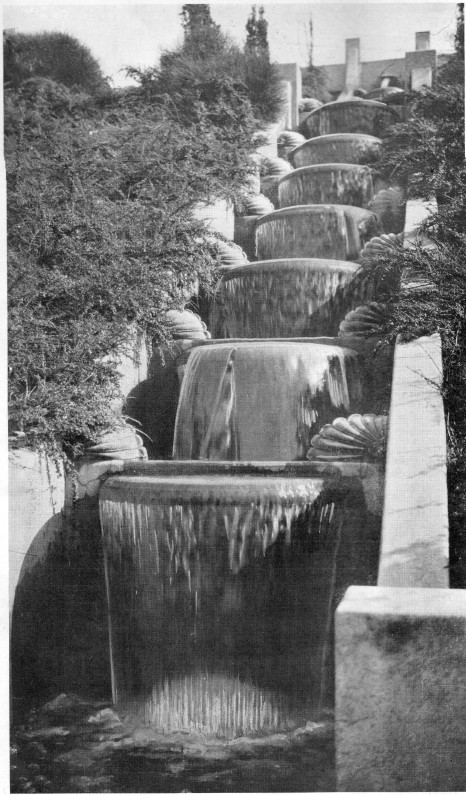 |
| From a 1931 picture from the Friends of the Cleveland Cascade. The cascades were lit with different colors of light. |
We went over to see the Cleveland Cascade today. Unfortunately the basins were all removed and so now there are just steps. Lots of people are still enjoying the steps as their daily exercise. It sure beats the gym.
The Nurserymen Discuss the Merits of Native Plants, 100 Years Ago

Many of the nurserymen at a meeting in 1913 were very enthusiastic about native plants: They are beautiful. They don't need summer water when they are established. They harmonize with the natural landscape. We should be selling them.
Friday, November 14, 2014
Tracking down Luther Burbank, two girls, and a dog

Thursday, November 13, 2014
Nursery and Exposition Logos, 1912 - 1913
 A smattering of logos from the Transaction and Proceedings of the Second Annual Meeting of the California Association of Nurserymen, Held in Oakland, on Thurs. Fri. and Sat. November 7-9, 1912 and the Transaction and Proceedings of the Third Annual Meeting of the California Association of Nurserymen, Held in Fresno, on Thurs. Fri. and Sat. October 16-18, 1913.
Sunday, October 12, 2014
The Quincunx, mystically considered
 |
While looking for some good pictures of roses for the current Días de los Muertos art project, I ran across this odd word - Quincunx. Odd and old, not to mention hard to pronounce.
Wikipedia has an entry for it. Merriam Webster has a definition. Visually it is the five spot on a domino - four dots on the corner and one in the middle. The origin is thus: "Latin quincunc-, quincunx, literally, five twelfths, from quinque five + uncia twelfth part". According to MW, first known use was 1485. Now I'm still thinking how does 5/12 relate to planting.
Both the California Nursery and Fancher Creek Nursery talked about orchard planting and the Quincunx. Roeding's Fruit Growers Guide (1919) probably helped disseminate the information.
Monday, September 29, 2014
Visiting with your favorite deceased horticulturist
 |
| The redwood has embraced this gravestone. |
Last week our landscape drawing class had a field trip to the Mountain View Cemetery. On the way up the hill, Bryn and Robert and I had a conversation which, because we were in a cemetery, it was only slightly morbid. Where did we want to be parked when we are done with our earthly bodies?
Over the years of taking care of the older folks, I have decided that I want to be sprinkled about in some of my favorite mushroom hunting grounds. I'm hoping to hitch a ride up and down the xylem and phloem of a redwood until I settle into a ring of wood. That redwood might be long lived enough that I could spend some time there before being made into a fence or a mole den.
So that's what I said - I just want my folks (whoever they are at that time) to sprinkle me up and down the coastal forests. [and that includes some local ones which shall remain nameless]
Subscribe to:
Posts (Atom)